Showing posts with label 3D Printers. Show all posts

Broken IKEA Lamp? Designer 3-D Prints His Own


The rice-paper shade on IKEA’s Regolit floor lamp isn’t the most durable material. When Samuel Bernier found an otherwise-working Regolit with a torn-up shade, he decided to replace it with a 3-D printed cover of his own design.

That quickly became 12 3-D printed shades of his own design. In seven colors. But with a low material cost Bernier can afford to swap them out whenever. He used SolidWorks to shape a series of bulbous shades and print them, first on his UP! 3-D printer, then on his MakerBot Replicator 2.

He calls the project Dentelle, French for lace.

“A lot of textile lampshades look like corsets,” he says. “Women used to customize them manually and took days to complete a simple piece. The industrial revolution changed the world of textiles and automatized it more than a century ago. Today’s 3-D printing revolution changes the world of mass customization.”

Thanks to that revolution, Bernier will be distributing the shades through several means: a limited print run of his own, digitally to factories around the world, and even to individual printer owners.

“The eradication of long-distance shipping and warehousing is a great opportunity of digital manufacturing and we have to start using this potential now,” he says.

Bernier, who is the artistic director for leFabShop, a digital manufacturing startup in France, previously won runner-up in Core77′s 2012 Design Awards for a series of 3-D printed alternative lids, designed to help re-use plastic bottles.

Images: Courtesy of Samuel Bernier and Veronique Huyghe

You have read this article 3D Printers / design with the title 3D Printers. You can bookmark this page URL https://emill-emil.blogspot.com/2012/12/broken-ikea-lamp-designer-3-d-prints.html. Thanks!

An affordable, high-resolution 3D printer for professional creators.


Thanks for an amazing Kickstarter campaign! The next chapter of 3D printing is just beginning.
Pre-order your Form 1 at Formlabs.com

Are you frustrated that low-end 3D printers don’t have the quality to make the true beauty of your designs real? Do you dream of having the power and resolution of a truly professional machine on your desktop? We’ve created an easy-to-use system that rivals the output of high-end printers at a fraction of the cost.
Formlabs is disrupting 3D printing.

Our reason for starting this project is simple: there are no low-cost 3D printers that meet the quality standards of the professional designer. As researchers at the MIT Media Lab, we were lucky to experience the best and most expensive fabrication equipment in the world. But, we became frustrated by the fact that all the professional-quality 3D printers were ridiculously expensive (read: tens of thousands of dollars) and were so complex to use. In 2011, we decided to build a solution to this problem ourselves, and we are now ready to share it with the world.

High resolution belongs on your desktop.

We’ve been hard at work for over a year, and with your help, we’re ready to take the Form 1 into full-fledged production. By supporting this effort, you’ll be the first to get your hands on an amazing 3D printer AND help usher in a new era of 3D printing - an era in which your creative output is no longer limited by price or dauntingly complex machines.

The Form 1 will change creative design.

We’ve gone to extraordinary lengths to design a complete 3D printing experience:
The Form 1 printer is engineered to produce high resolution parts with the touch of a button
Form software is intuitive and simple to use so you can spend less time setting up prints and more time designing
The Form Finish post-processing kit keeps your desktop organized so that you can easily put the finishing touches on your masterpiece

Read on for more details on what you’ll help bring into the world (and onto your desktop) if you support this effort.

Hardware - The Form 1:

For most designers, the extruded plastic (i.e. FDM) of low-end printers is simply not capable of the high resolution and quality surface finish necessary for professional work. So, we decided to go straight for the real deal: astereolithography printer we call the Form 1.

Stereolithography (SL) is the gold standard for accuracy and resolution in the 3D printing world, reaching layer thicknesses and feature sizes that are worlds ahead of what is possible with FDM. The process is pretty straightforward - a laser is used to draw on the surface of a liquid plastic resin that hardens when exposed to a certain wavelength of light. The laser draws and hardens a layer at a time until the entire model is built. It’s simple, reliable, and quiet.

Unfortunately, SL is traditionally one of the most expensive 3D printing processes. With pricey lasers and high-precision optical components, SL 3D printers can easily cost tens or even hundreds of thousands of dollars. Until now. Check out these pictures of parts made with the Form 1 as compared to a currently available FDM printer:


After a great deal of research, engineering, and experimentation, we’ve figured out how to do it at a much, much lower cost, making this premium technology available to everyone.

The results are amazing: the Form 1 can print layers as thin as 25 microns (0.001 in) with features as small as 300 microns (0.012 in) in a build volume of 125 x 125 x 165 mm (4.9 x 4.9 x 6.5 in). This means you can print complex geometries with the exquisite details and beautiful surface finish that will make your creations stand out.

Form print software:

Great hardware is only half the battle. We painstakingly designed our Form software to have a simple, intuitive user experience that streamlines the process of importing .STL models from any 3D CAD package. Generating smart support structures for complex geometries and sending jobs to the printer is as easy as a few clicks.


A key advantage of the Form software is the ability to precisely generate thin, breakable support structures that serve their purpose during printing but are easily removed afterward. Test users have delightfully compared this part removal to a feeling almost like separating Velcro. You can finally print those designs with crazy overhangs!

Materials:

When the Form 1 is released, it will come with our first material - a neutral matte gray that is great for look-and-feel models, standalone parts, or even as a base color for painting.

After a successful launch (thanks to your support!), we will continue development of an entire palette of materials for your printer. A variety of colors, transparency, flexibility, and even burnout capability for lost wax casting processes are all possible with SL.

Accessories - Form Finish kit:

With any 3D printing process, there are key finishing steps to get your print into its final and ready-to-use form. With SL, each part comes out of the printer with a small amount of liquid resin on its surface.

We’ve designed the Form Finish kit - a finishing tray and accessories set to assist you and keep your workspace clean and organized during this process.

After printing, all you need to do is remove the build platform from the printer, set it into the tray, snap the model off its supports, and use the rinsing basket to clean the print for final use. Check out our website for step by step photos!
We are ready for full production with your support.

So where are we in this whole process? We’ve:
Formed an awesome team in Boston, Montreal, and London
Engineered the system to be mass-manufactured
Built and tested 7 generations of prototypes
Tested a wide range of material formulations
Written and optimized thousands of lines of code
Tested a production run of alpha units

We’re nearly ready to set up full-scale manufacturing to get your Form 1 delivered as soon as possible. We take this last crucial step seriously, and we’ll need a lot of support to do the job right. That’s why we’ve turned to Kickstarter to get the production lines up and running!

If you decide to pitch in, you’ll get a discount and be one of the first to have our product on your desktop. But more importantly, you’ll play a huge part in starting this revolution in 3D printing by providing your feedback and creating amazing things with the Form 1. We can’t wait to see what you can design!
What do the Gyrocube and T-Shirt rewards look like?

They look like this:


Spiffy, eh?

The Formlabs Gyro was inspired by "Gyro the Cube" designed by Virtox. For a brief history of the design click here.
Special thanks to:

Juriaan Booij

Andy Ryan

Nervous System

Skylar Tibbits

Nadia Cheng

Philippa Mothersill

Jon Hirschtick

Charlie the formlab[rador]


RISKS AND CHALLENGESLearn about accountability on Kickstarter


Similar to many Kickstarter projects, we face several key risks and challenges in sparking this revolution in 3D printing. The primary risks for us include:

ENGINEERING

To achieve the level of simplicity in user experience that we have, we have to design and engineer a very complex system. We have taken two key steps to ensure our engineering success. 1) We have formed an amazing team of engineers and designers, and 2) we test our printers with an obsession for perfection. In the last year, we have built 7 generations of prototypes, a production run of alpha machines, we will have a run of beta machines with significant user testing, and we keep enormous amounts of data to guide our future work.

SUPPLY CHAIN AND LOGISTICS

Many Kickstarter campaigns can encounter problems when taking their prototypes to production. This includes issues finding suppliers and engineering products for mass-production. Smooth execution is absolutely essential to overcoming such risks. We take this lesson seriously and have been working for months negotiating with suppliers, testing component quality, and building a team that can execute on our promises. Our plans are nearly in place, and we now mainly require the resources to execute them.

TEAM

Finding the right people is a challenge for any endeavor. Success in 3D printing requires a team of talented, passionate, and motivated designers, engineers, and entrepreneurs. We have already formed a truly awesome (and fun!) team, but we will have to bring in more Formlings to realize this dream. In fact, we are actively looking for new members to join Formlabs and hit the ground running! Check out our website for more information.
You have read this article 3D Printers / design with the title 3D Printers. You can bookmark this page URL https://emill-emil.blogspot.com/2012/11/an-affordable-high-resolution-3d.html. Thanks!

Building Bytes proposes a new method of fabricating architecture


About

Building Bytes proposes a new method of fabricating architecture; desktop 3D printers become portable, inexpensive brick factories for large-scale construction.

The first phase of this research was conducted during a 6-week residency at the European Ceramic Work Centre (sundaymorning@ekwc) which focused on how to 3D print with ceramics at the scale of architecture. Working within fixed limitations (the size of a desktop 3D printer, capacity of the material storage system and the properties of clay) led to research into bricks. While the material and building unit are ancient and fairly universal, Building Bytes proposes to revolutionize the fabrication technique.

This fabrication system, including the materials and technology, allows Building Bytes to be accessible worldwide. The bricks are made from a liquid slip cast recipe of earthenware ceramics, which is typically used for casting molds, while a standard desktop 3D printer is connected to an extrusion system consisting of plastic cartridges and air pressure. The only customization is a material extrusion head that only requires minimal changes to existing printers.
During the residency four potential applications were tested:
1) columns and towers
2) domes of interlocking bricks
3) vertical tiling
4) modular honeycomb stackable bricks

This research aimed to test the system with two design/ fabrication systems: uniformity (the same brick printed multiple times) and variation (unique bricks that create a specific form).

The next phase of research will investigate additional “byte” materials.


X-Brick
Designed to maximize visual opacity through walls, optimize printing time, limit material usage, and test non-modular constructions. The X-Brick prototype structure creates an undulating surface by using unique bricks per row.

Applications: Interior and Exterior Walls, Columns, Sun Shading

Printing time: 15 minutes
Layer height: 2mm
Material: White earthenware (slip cast recipe)
Finish: Raw – unglazed
Dimensions: 10cm x 20cm x 4cm


Ribbed Bricks


Designed for column applications, Ribbed Bricks have a distinct outer surface that is both structural and ornamental. The material stability while printing drives the unique outline, which can be designed any number of ways with no increase in fabrication complexity. Each brick in the column prototypes is unique.

Applications: Columns, Window or Door Openings

Printing time: 15 minutes
Layer height: 2mm
Material: White earthenware (slip cast recipe)
Finish: Raw – unglazed
Dimensions: 15cm x 15cm x 4cm

Interlocking Brick


These bricks are an exploration into the use of interlocking bricks in large dome structures. The interior bracing provides stability, while the exterior can expose the structure (as in the prototype) or be clad in another texture (which is integral to the brick design).

Applications: Walls, Domes, Vaults

Printing time: 20 minutes
Layer height: 2mm
Material: White earthenware (slip cast recipe)
Finish: Raw – unglazed
Dimensions: 10cm x 20cm x 4cm


Honeycomb Brick


One brick, three orientations. Honeycomb Bricks are modular and stackable, creating different forms based on their configuration. The assemblies shown are constructed from the standard Honeycomb Brick, offering a sample of the possible stacking configurations.

Applications: Interior and Exterior Walls, Sun Shading, Exterior Ground Cover

Printing time: 20 minutes
Layer height: 2mm
Material: White earthenware (slip cast recipe)
Finish: Raw – unglazed
Dimensions: 5cm x 20cm x 4cm


http://buildingbytes.info/about/


You have read this article 3D Printers / design with the title 3D Printers. You can bookmark this page URL https://emill-emil.blogspot.com/2012/11/building-bytes-proposes-new-method-of.html. Thanks!

New 3D printing technique using robotic arms and UV cured resin

Using a moving print bed for large-scale printing.


Phantom Geometry, winner of the new Gehry Prize thesis award, is a project by students from the Southern California Institute of Architecture. It was developed in the Robot House, a facility where students have acess to advanced robotic arms, under the guidance of Peter Testa and Devyn Weiser.

The original article on FastCo appears to suggest that the innovation in the project was to use a projector and UV cured resin to produce 3D prints. I hope that’s not what the prize was for, considering that this has been doneseveral times already.

That confusion aside, this is a fascinating project. With typical UV resin 3D printing, the only movement of the print bed is to slowly lower, letting the project light cure one layer of resin at a time. In this case, both the print bed of resin and the projector are attached to robotic arms. This allows the machine to print structures many times larger than the print bed itself. It’s difficult to describe, so please watch the video.

Via FastCo


At SCI-Arc’s Robot House, architecture students have access to six massive robotic arms.


Last month, the school awarded its first Gehry Prize, given out to the best thesis, to a husband/wife duo who developed their project using the robot arms.


Liz and Kyle von Hasseln developed an entirely new fabrication process that uses light from an off-the-shelf projector to cure resin

One robotic arm holds a bed filled with UV-sensitive resin.


The other holds a digital overhead projector, which projects steady UV light over the bed.


When the UV rays come in contact with the resin, it cures instantly.


The von Hasselns are interested in the technique because it gives them the ability to alter the model as it’s being printed. They can sculpt the product as it emerges.


The Gehry Prize was established earlier this year, after Frank Gehry gave the school $100,000.


You have read this article 3D Printers / design with the title 3D Printers. You can bookmark this page URL https://emill-emil.blogspot.com/2012/11/new-3d-printing-technique-using-robotic.html. Thanks!

3D Printers In A Prius Prove This Technology is Road Ready

What happens when you put a couple of cheap 3D printers in the back of your Prius, and drive around making products for people. Can you create a business? What are the best products to try and make? Two guys are trying to answer these questions with a new project called PocketFactory.
Using 3D Printing To Grow A Small Business
Bilal Ghalib and Alex Hornstein have put four consumer level (sub-$2,000) 3D printers in the back of their car and are making their way across the US. Their goal is to start a business of designing, producing and selling products made on these printers. They're also open sourcing everything about their adventure so anyone interested in duplicating the business can do so.

The motivation is simple. Thanks to 3D printing -- something we've seen really start to skyrocket lately as 3D printers become more accessible -- the design and production of products can be virtually instant. For many products, there is no need to make it a long process of design, prototype, fix design, re-prototype, fix design, and then make a mass production of a product and cross your fingers you sell them all. Instead, a product can be printed out, modifications or customization made right away, and then a finished product can come off the printer immediately. You're not making more than you need or wasting material, and you're making sure each one is just right.
As Hornstein notes during a conversation we had last week, the new consumer-level 3D printers are of a high enough quality that they can become essentially a production machine, yet they're at a low enough price that the barrier to entry is quite low. Essentially, this technology is becoming more like a gadget for your home than a machine for a shop.
3D Printing Technology Is More Accessible, Flexible
This is an excellent example of the benefits of smaller, smarter technology helping designers and creative people produce goods on a small scale. The more companies tweak the technology to work for individual people, the more we can see small businesses run off of filling specific needs on a small, local level -- rather than shopping for mass-produced plasticrap that might only sort of solve a problem. It is a beautiful combination of technology and the maker community, which will some day soon help create small businesses filling niche needs. Yes, you could call it a green manufacturing revolution.
And, as we noted when talking about Cubify at CES, the cartridges used to print objects will soon be filled with all sorts of materials, from compostable and biodegradable materials to actual food.
Creating a 3D Printing Business On The Go
Gahlib and Hornstein are trying to release 1-2 products each week of the trip. During the day they hit the public markets and set up their print shop. They take and fill orders of products they've already devised. At night, they head back to the hotel to fill any remaining orders and to design and test new products to sell.
The duo started making iPhone cases, which was the first thing family members asked for when they saw the printers over the holidays. (Yes, you can buy one online.) As Hornstein commented, the first products are relatively unambitious -- they're just trying to see what people want and will buy. But the creativity is starting to roll out. They're making custom belt buckles and 3D portraits of people.
That creativity also includes more interesting accessories for iPhones, including the ghettoblaster -- a great way to rock your music:
Hornstein noted that as a designer, he's never experienced this level of speed of seeing an idea turn into a product, and turn into a profit. It is now feasible to design, test and produce something within a day or two, and to sell it at a relatively low cost. And that is why they are so interested in finding out what starting up a business with a 3D printer might entail. They're encouraging people to copy them, and will open up everything right down to their account books at the end of the trip. You can follow the successes and failures on PocketFactory as well as check out their route on the map. Meet up with them if you're in one of the cities they're visiting! They'll end up in New York by February 11, 2012.   
more in
You have read this article 3D Printers / Robot Gadgets with the title 3D Printers. You can bookmark this page URL https://emill-emil.blogspot.com/2012/01/3d-printers-in-prius-prove-this.html. Thanks!

Now You Can Do 3-D Printing Out of Sawdust


The rapid-prototyping juggernaut Freedom of Creation is out with what it calls "the most ecological way to create products": sawdust.
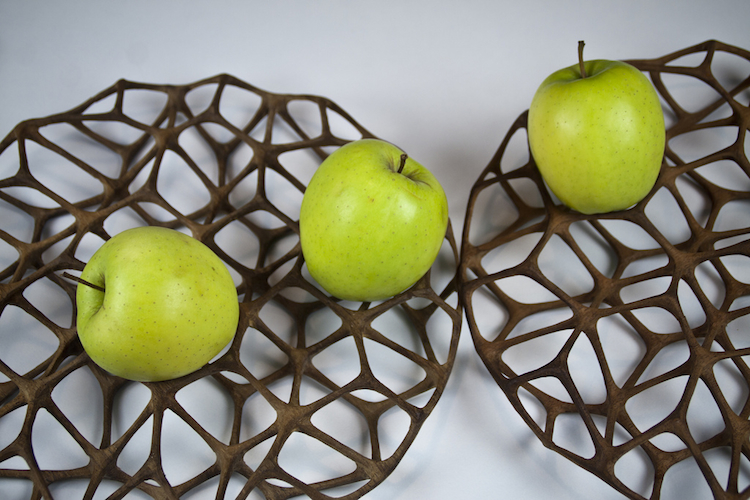
Used to be, if you wanted to make a detailed shape out of wood -- for a nice little fruit bowl, say -- you had to carve it by hand using a big chunk of timber, which is a.) time-consuming b.) expensive and c.) bad for the environment. (Think of all the scraps you end up with.) Now, you can just pull it out of a printer.
The Dutch rapid-prototyping outfit Freedom of Creation (FOC) announced today that it has added wood -- one of the planet’s most abundant natural resources -- to its suite of 3-D printing materials. Mind you, this isn’t wood resembling anything you might buy at Home Depot. It’s sawdust that, when mixed with a “binder” (basically glue), forms something approximating the look of real wood and the strength of MDF. FOC calls it their “Tree-D printer.” Cute.
The big selling point here is that it's gentler on Mother Nature than the materials rapid prototyping typically resorts to, like plastics and metals. Sawdust is, after all, a waste product. For the fruit basket shown here, FOC sourced sawdust from local wood workshops that would’ve tossed the stuff otherwise. As FOC’s Brian Garrett tells Co.Design: “It was a good deal since this way they also got their workshops cleaned for free.”
There are limitations. Though the products do look "woody," they don't quite replicate the original wood, owing to discoloration that results when the binder hardens. What's more, FOC can only print in teak and mahogany. Garrett explains: "Balsa and other light wood types have not been possible yet, because they are so light that spreading equal layers is still a problem. We are currently working on improving this with using different types of re-coaters."
Still it's a promising development in the field of 3-D printing, which bills itself as a paragon of sustainability but, as industry insiders tell it, hasn't always lived up to the hype. FOC seems particularly excited about the formal and aesthetic possibilities "Tree-D" printing affords designers. “There is no wood carver on earth who could possibly make such complex things and especially with this kind of fine detail,” Garrett says. Well, that might be a slight exaggeration.

http://www.fastcodesign.com/1663532/3-d-print-insanely-complex-and-eco-friendly-designs-out-of-wood 

Here you can see a comparison between a gray Laser Sintered Macedonia tray to a teak tray. The accuracy, which we have been able to create is quite astonishing with a very modest budget.

The strength of the objects is very similar to MDF, but naturally the complexity of the geometries we are able to produce is on a totally different level than compared to simple pressed wood. The process still takes about twice as much time compared to Selective Laser Sintering.
The digital 3D computer file we use to manufacture the Macedonia Fruit Tray.

The 3D printing process of the Macedonia tray in wood, picture shows the base material, sawdust and a finished layer of the Macedonia tray.

Cleaning process of sawdust of the tray after production.


We are currently looking at partnerships to further develop and commercialize our Tree-D printing technology. Later this year we plan to launch our first interior products using this technology. If you are interested in partnering with Freedom Of Creation please contact: michiel@freedomofcreation.com


You have read this article 3D Printers / design / Robot Gadgets with the title 3D Printers. You can bookmark this page URL https://emill-emil.blogspot.com/2011/03/now-you-can-do-3-d-printing-out-of.html. Thanks!
Related Posts Plugin for WordPress, Blogger...